

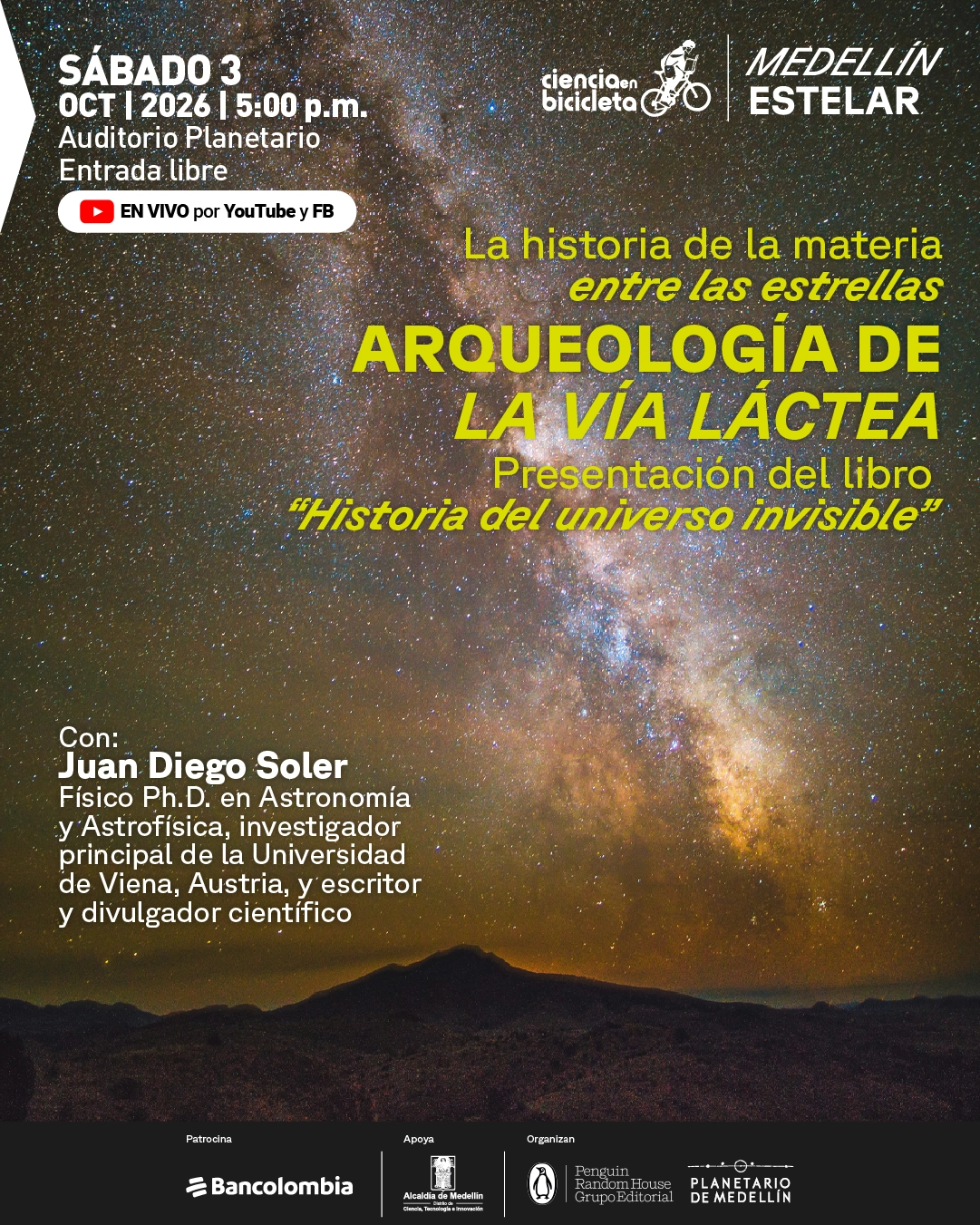
Between the stars, there appears to be nothing. But there, in the darkness of the Milky Way, lie enormous clouds of gas and dust: matter that circulates, accumulates, collapses, and, over time, can become new stars. The hydrogen that inhabits that interstellar space is, to a large extent, the raw material for the next generation of stars.
In this talk, Colombian astrophysicist Juan Diego Soler invites us to explore the history of how we have come to understand the matter we cannot see directly. This journey begins with early observations of the dark patches in the Milky Way and continues through the first questions about the nature of these regions, the visionary perspective of Francisco José de Caldas, the work of the women who performed astronomical calculations at Harvard, and the arrival of radio telescopes—instruments that allowed us to "listen" to a part of the universe that remained invisible to our eyes.
This story reveals some of the great transformations in astronomy: how we went from observing the appearance of the sky to studying its composition, movement, and history; how we learned to detect atoms in the depths of our galaxy; and how new technologies changed our idea of what it means to "see" the universe.
The talk will also allow us to explore a fundamental question in contemporary astrophysics: how is matter organized between stars and how does it become new stars? Much of Soler's scientific work lies precisely in the study of these gas and dust structures, as he has investigated interstellar hydrogen, magnetic fields, and star formation processes. His work with radio observations of the Milky Way led, among other results, to the identification of the giant hydrogen structure known as Magdalena.
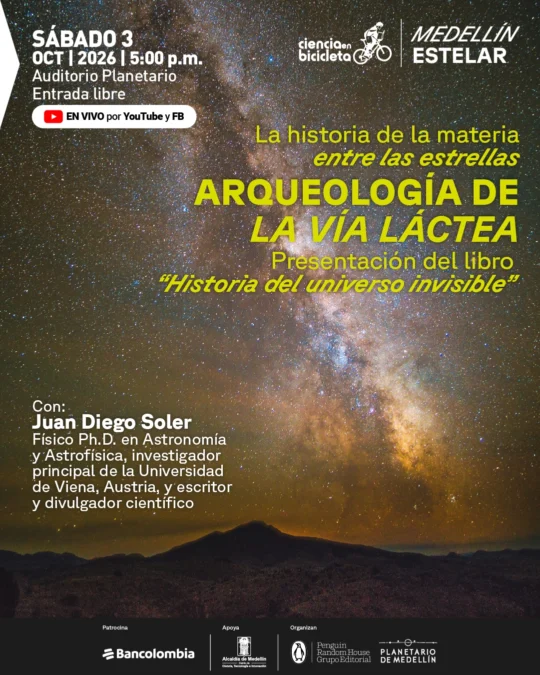
At the meeting, Juan Diego will also present his new book, History of the Invisible Universe, a story of how we learned to look beyond the stars and discover the matter that fills the seemingly empty space.
This event is free to enter and does not require prior registration.
Between the stars, there appears to be nothing. But there, in the darkness of the Milky Way, lie enormous clouds of gas and dust: matter that circulates, accumulates, collapses, and, over time, can become new stars. The hydrogen that inhabits that interstellar space is, to a large extent, the raw material for the next generation of stars.
In this talk, Colombian astrophysicist Juan Diego Soler invites us to explore the history of how we have come to understand the matter we cannot see directly. This journey begins with early observations of the dark patches in the Milky Way and continues through the first questions about the nature of these regions, the visionary perspective of Francisco José de Caldas, the work of the women who performed astronomical calculations at Harvard, and the arrival of radio telescopes—instruments that allowed us to "listen" to a part of the universe that remained invisible to our eyes.
This story reveals some of the great transformations in astronomy: how we went from observing the appearance of the sky to studying its composition, movement, and history; how we learned to detect atoms in the depths of our galaxy; and how new technologies changed our idea of what it means to "see" the universe.
The talk will also allow us to explore a fundamental question in contemporary astrophysics: how is matter organized between stars and how does it become new stars? Much of Soler's scientific work lies precisely in the study of these gas and dust structures, as he has investigated interstellar hydrogen, magnetic fields, and star formation processes. His work with radio observations of the Milky Way led, among other results, to the identification of the giant hydrogen structure known as Magdalena.
At the meeting, Juan Diego will also present his new book, History of the Invisible Universe, a story of how we learned to look beyond the stars and discover the matter that fills the seemingly empty space.
This event is free to enter and does not require prior registration.
There are no similar listings
There are no partner restaurants or hotels in this area

















 swipe down and choose